| |
[edit] Secondary schools
Christchurch is well-known for several very traditional schools of the English public school type, such as Christ's College, St Andrew's, St. Bede's College, Villa Maria College, St. Margaret's College and Rangi Ruru Girls' School, but also has several less conventional schools such as Unlimited Paenga Tawhiti and Hagley Community College. Christchurch is also the location of Burnside High School, well known for its specialist music programme, and the second largest school in New Zealand with 2,650 pupils. Cashmere High School at Rose Street is another large co-educational secondary school.
[edit] Tertiary institutions
A number of tertiary education institutions have campuses in Christchurch, or in the surrounding areas.

Christchurch Brill Tram No 178 on the heritage tramway
[edit] Transport
Christchurch is served by Christchurch International Airport and by buses (local and long-distance) and trains. The local bus service, known as Metro, is provided by Environment Canterbury. The car, however, remains the dominant form of transport. The central city has very flat terrain and the City Council are establishing a network of cycle lanes on roads.
There is a functioning tram service in Christchurch, but as a tourist attraction, its loop is restricted to a circuit of the central city. The trams were originally introduced in 1905, ceased operating in 1954,[16] but returned to the inner city (as a tourist attraction) in 1995. In addition to nomal bus services, Christchurch also has a pioneering zero-fare hybrid bus service, the Shuttle, in the inner city.
- See also: Public transport in Christchurch
The Main North Line railway travels northwards via Kaikoura to Picton and is served by the famous TranzCoastal passenger train, while the Main South Line heads to Invercargill via Dunedin and was used by the Southerner until its cancellation in 2002. The most famous train to depart Christchurch is the TranzAlpine, which travels along the Main South Line to Rolleston and then turns onto the Midland Line, passes through the Southern Alps via the Otira Tunnel, and terminates in Greymouth on the West Coast. This trip is often regarded to be one of the ten great train journeys in the world for the amazing scenery through which it passes. The TranzAlpine service is primarily a tourist service and carries no significant commuter traffic. Commuter trains used to operate in Christchurch but were progressively cancelled in the 1960s and 1970s. The last such service, between Christchurch and Rangiora, ceased in 1976.
[edit] History
-
[edit] Overview
Archeological evidence found in a cave at Redcliffs in 1876 has indicated that the Christchurch area was first settled by moa-hunting tribes about 1250. Maori oral history relates that humans occupied the area around the year 1000. These first inhabitants were thought to have been followed by the Waitaha tribe, who are said to have migrated from the East coast of the North Island in the 16th century. Following tribal warfare, the Waitaha (made of three peoples) were dispossessed by the Ngati Mamoe tribe. They were in turn subjugated by the Ngai Tahu tribe, who remained in control until the arrival of European settlers.
Following the purchase of land at Putaringamotu (modern Riccarton) by the Weller brothers whalers of Otago and Sydney a party of European settlers led by Herriott and McGillivray established themselves in what is now the Christchurch area, early in 1840. Their abandoned holdings were taken over by the Deans brothers in 1843 who stayed. The First Four Ships were chartered by the Canterbury Association and arrived on 16 December 1850, bringing the first 792 of the Canterbury Pilgrims to Lyttelton Harbour. These sailing vessels were the Randolph, Charlotte-Jane, Sir George Seymour, and Cressy. The Canterbury Pilgrims had aspirations of building a city around a cathedral and college, on the model of Christ Church in Oxford.[17] The name "Christ Church" was decided prior to the ships' arrival, at the Association's first meeting, on 27 March 1848.
Captain Joseph Thomas, the Canterbury Association's Chief Surveyor, surveyed the surrounding area. By December 1849 he had commissioned the construction of a road from Port Cooper, later Lyttelton, to Christchurch via Sumner.[18] However this proved more difficult than expected and road construction was stopped while a steep foot and pack horse track was constructed over the hill between the port and the Heathcote valley, where access to the site of the proposed settlement could be gained. This track became known as the Bridle Path, because the path was so steep that pack horses needed to be led by the bridle.[19]
Goods that were too heavy or bulky to be transported by pack horse over the Bridle Path were shipped by small sailing vessels some eight miles (13 km) by water around the coast and up the estuary to Ferrymead. New Zealand's first public railway line, the Ferrymead railway, opened from Ferrymead to Christchurch in 1863. Due to the difficulties in travelling over the Port Hills and the dangers associated with shipping navigating the Sumner bar, a railway tunnel was bored through the Port Hills to Lyttelton, opening in 1867.[20]
Christchurch became a city by Royal Charter on 31 July 1856, the first in New Zealand. Many of the city's Gothic buildings by architect Benjamin Mountfort date from this period.
Christchurch was the seat of provincial administration for the Province of Canterbury.
In 1947, New Zealand's worst fire disaster occurred at Ballantyne's Department Store in the inner city, with 41 people killed in a blaze which razed the rambling collection of buildings.[21]
The Lyttelton Road Tunnel between Lyttelton and Christchurch was opened in 1964.[22]
Christchurch was also host to the 1974 British Commonwealth Games.
[edit] Gateway to the Antarctic
Christchurch has a history of involvement in Antarctic exploration – both Robert Falcon Scott and Ernest Shackleton used the port of Lyttelton as a departure point for expeditions, and there is a statue of Scott, sculpted by his widow, in the central city.
Christchurch International Airport serves as the major base for the Italian and United States Antarctic programs as well as the New Zealand Antarctic programme. The International Antarctic Centre provides both base facilities and a museum and visitor centre. The United States Navy and latterly the United States Air National Guard, augmented by the New Zealand and Australian air forces, use Christchurch Airport as take-off for the main supply route to McMurdo and Scott Bases in Antarctica. The Clothing Distribution Center (CDC) in Christchurch, has more than 140,000 pieces of extreme cold weather (ECW) gear for issue to nearly 2,000 U.S. Antarctic Program (USAP) participants in the 2007-08 season.[23]
[edit] Visitor attractions

Cathedral Square in Christchurch, with Christ Church in the background.

The Christchurch Art Gallery
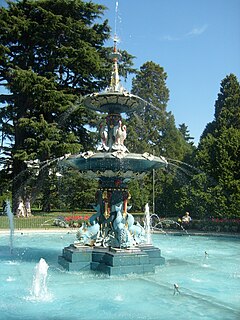
Water fountain at Christchurch Botanical Gardens.
[edit] Entertainment
[edit] Parks & Nature
The large number of public parks and well-developed residential gardens with many trees has given Christchurch the name of The Garden City.[24] Hagley Park and the 30-hectare (75 acre) Christchurch Botanic Gardens, founded in 1863, are in the central city, with Hagley Park being a site for sports such as golf, cricket, netball, and rugby, and for open air concerts by local bands and orchestras.
[edit] Cinema & Theatre
While historically most cinemas were grouped around Cathedral Square,[25] only the Regent complex remains there, which was rebuilt as 'Regent on Worcester' in 1996. Only one of the first generation of suburban cinemas, the Hollywood in Sumner, remains open.[26] The largest multiplexes are the Hoyts 8 in the old Railway Station on Moorhouse Avenue and Reading Cinemas (also eight screens) in the Palms shopping centre in Shirley. The recently (2005)[27] opened Hoyts in Riccarton had the largest screen in New Zealand – although this has recently (2007) been surpassed by Auckland, which now has the largest movie theatre screen in the world, incorporated into the new Sylvia Park shopping complex.
The Rialto Cinemas on Moorhouse avenue specialise in international films and art house productions. The Rialto also hosts the majority of the cities various film festivals and is home to the local film society.
The Christchurch Arts Centre includes two art house cinemas, Cloisters and The Academy, screening a wide selection of contemporary, classic and foreign language films.
There is an active film society in the city,[28].
Christchurch has one full-time professional theatre, the Court Theatre,[29] which is based in the Christchurch Arts Centre. There is also an active recreational theatre scene.
The city is known for its many live acts.[30][31] and also has a professional symphony orchestra.[32]
There are usually buskers around the town square, and Christchurch also hosts the World Buskers Festival in January each year.
In recent movements, hip hop has effectively landed in Christchurch. In 2000, First Aotearoa Hip Hop Summit was held there. And in 2003, Christchurch’s own Scribe (rapper), released his debut album in New Zealand and has received five times platinum in that country, in addition to achieving two number one singles.[33][34]
[edit] Venues
The Westpac Arena is New Zealand's second largest permanent multipurpose arena, seating between 5000 and 8000, depending on configuration. It is home of the Canterbury Rams basketball team, and Canterbury Tactix netball side. It was the venue for the 1999 World Netball championships and has been host to many concerts in recent years.
The Christchurch Town Hall Auditorium (2000 seats, opened 1974) was the first major auditorium design by architects Warren and Mahoney and acousticians Marshall Day. It is still recognised as a model example of concert-hall design. It has an excellent modern pipe organ.
Christchurch also has a Casino,[35] and there are also a wide range of live music venues[36][37] – some short-lived, others with decades of history.
[edit] Sports
[edit] Events
[edit] Venues
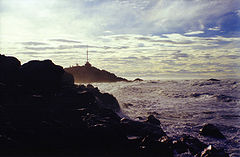
Winter afternoon on the Christchurch coast.
- Westpac Arena in Addington, Christchurch. Once hosted the World Netball Championship and continues to host international basketball and netball games.
[edit] Sister cities
Christchurch has seven sister cities around the world. They are:[39]
 Adelaide, South Australia, Australia Adelaide, South Australia, Australia Christchurch, Dorset, United Kingdom Christchurch, Dorset, United Kingdom Lanzhou, Gansu, China Lanzhou, Gansu, China Kurashiki, Okayama, Japan Kurashiki, Okayama, Japan Seattle, Washington, United States of America Seattle, Washington, United States of America Songpa-gu, Seoul, South Korea Songpa-gu, Seoul, South Korea- Wuhan, Hubei, China
[edit] References
- , Section 3.4 Greater Christchurch Area (PDF) (Greater Christchurch Urban Development Strategy, Christchurch City Council, 2007)
- , a b A History of Canterbury, Vol. 1 - Sir James Hight & Straubel, C.R.; Canterbury Centennial Association and Whitcombe and Tombs, Christchurch 1957, Page 121
- , Otautahi (from the Christchurch City Library website)
- , Christchurch City Council definition
- , Canterbury's damaging nor'wester (from the Metservice NZ website)
- , Mean Number Of Days Of Ground Frost (from the NIWA website)
- , Air Pollution Today (from the Environment Canterbury website)
- , [1] (from the Environment Canterbury website)
- , Niwa Science climate data.
- , 2001 Regional Summary, Statistics New Zealand
- , a b 2006 Regional Summary Tables by Regional Council, Statistics New Zealand
- , The Sister City link with Christchurch (from christchurch.org, a Christchurch City Council website)
- , Environment Canterbury (official regional council website)
- , Canterbury District Health Board (official district health board website)
- , Carl Bertelsmann-Preis 1993: Kommunalverwaltung (from the Bertelsmann Foundation website, in German)
- , A Wheel on Each Corner, The History of the IPENZ Transportation Group 1956-2006 - Douglass, Malcolm; IPENZ Transportation Group, 2006, Page 12
- , Cathedral History (from the official Christ Church cathedral website)
- , Captain Thomas and the Streets of Christchurch. Christchurch City Libraries.
- , Rescue, the Sumner community and its lifeboat service - Amodeo, Colin (editor), Christchurch: Sumner Lifeboat Institution Incorporated, 1998
- , Chch City Libraries
- , Ballantyne's fire
- , Te Ara
- , Looking good in the Antarctic (web). Clothing Distribution Center in Christchurch, New Zealand, outfits USAP participants for the trip south. The Antarctic Sun (January 10, 2008). Retrieved on 2008-01-13.
- , Christchurch, the Garden City (from the Christchurch City Council website)
- , Regent Theatre [1930-1976] (from the Canterbury Film Society website)
- , Christchurch Cinemas :: Hollywood Theatre
- , Hoyts Riccarton [2005 - ]. Canterbury Film Society.
- , Canterbury Film Society (from the official Canterbury Film Society website)
- , Court Theatre (from the official Court Theatre website)
- , The Official Launch of NZ Music Month 2007!. New Zealand Music Commission.
- , Celebrating Christchurch Music in NZ Music Month. Scoop.
- , Christchurch Symphony (from the official Christchurch Symphony Orchestra website)
- , Henderson, April K. “Dancing Between Islands: Hip Hop and the Samoan Diaspora.” In The Vinyl Ain’t Final: Hip Hop and the Globalization of Black Popular Culture, ed. by Dipannita Basu and Sidney J. Lemelle, 180-199. London; Ann Arbor, MI: Pluto Press, 2000
- , Aotearoa hiphop timeline.
- , Christchurch Casino (official Christchurch Casino website)
- , Christchurch's music scene today. Christchurch City Libraries.
- , Christchurch Live Music Venues. Christchurch Music Industry Trust.
- , Christchurch Park History. Christchurch Park.
- , Sister Cities of Christchurch (from the Christchurch City Council website)
[edit] Bibliography
- Reed, A. W. (2002). The Reed Dictionary of New Zealand Place Names. Auckland: Reed Books. ISBN 0-7900-0761-4.
- Rice, Geoffrey (with assistance from Jean Sharfe)(1999) Christchurch changing: an illustrated history Christchurch: Canterbury University Press. ISBN 0-908812-53-1 (pbk.)
[edit] External links
Wikimedia Commons has media related to:
Official Organisations:
Culture & Information:
Tourism & Maps:
(Source: Wikipedia) |
|