| |
Carrot, raw
Nutritional value per 100 g (3.5 oz) |
| Energy 40 kcal 170 kJ |
|
|
Percentages are relative to US
recommendations for adults.
|
The carrot (Daucus carota subsp. sativus, Etymology: Middle French carotte, from Late Latin carota, from Greek karoton, originally from the Indoeuropean root ker- (horn), due to its horny shape) is a root vegetable, usually orange or white, or red-white blend in colour, with a crisp texture when fresh. The edible part of a carrot is a taproot. It is a domesticated form of the wild carrot Daucus carota, native to Europe and southwestern Asia. It has been bred for its greatly enlarged and more palatable, less woody-textured edible taproot, but is still the same species.
It is a biennial plant which grows a rosette of leaves in the spring and summer, while building up the stout taproot, which stores large amounts of sugars for the plant to flower in the second year. The flowering stem grows to about 1 metre (3 ft) tall, with an umbel of white flowers.
Uses
Carrots can be eaten in a variety of ways. They are often chopped and boiled, fried or steamed, and cooked in soups and stews, as well as baby and pet foods. A well known dish is carrots julienne. Grated carrots are used in carrot cakes, as well as carrot puddings, an old English dish thought to have originated in the early 1800s. The greens are edible as a leaf vegetable, but are rarely eaten by humans. Together with onion and celery, carrots are one of the primary vegetables used in a mirepoix to make various broths.
Ever since the late 1980s, baby carrots or mini-carrots (carrots that have been peeled and cut into uniform cylinders) have been a popular ready-to-eat snack food available in many supermarkets.
Carrot juice is also widely marketed, especially as a health drink, either stand-alone or blended with fruits and other vegetables.
The carrot gets its characteristic and bright orange colour from ß-carotene, which is metabolised into vitamin A in humans when bile salts are present in the intestines.[1] Massive overconsumption of carrots can cause hypercarotenemia, a condition in which the skin turns orange (although effects are less dangerous than those of vitamin A, which can cause liver damage). Carrots are also rich in dietary fibre, antioxidants, and minerals.
Lack of Vitamin A can cause poor vision, including night vision, and vision can be restored by adding Vitamin A back into the diet. The urban legend that says eating large amounts of carrots will allow one to see in the dark developed from stories of British gunners in World War II who were able to shoot down German planes in the darkness of night. The legend arose during the Battle of Britain when the RAF circulated a story about their pilots' carrot consumption as an attempt to cover up the discovery and effective use of radar technologies in engaging enemy planes.[2][3] It reinforced existing German folklore and helped to encourage Britons - looking to improve their night vision during the blackouts - to grow and eat the vegetable.
Ethnomedically, the roots are used to treat digestive problems, intestinal parasites, and tonsillitis or constipation.
History
The wild ancestors of the carrot are likely to have come from Afghanistan, which remains the centre of diversity of D. carota, the wild carrot. Selective breeding over the centuries of a naturally-occurring subspecies of the wild carrot, Daucus carota subsp. sativus has produced the familiar garden vegetable.[4][5]
In early use, carrots were grown for their aromatic leaves and seeds, not their roots. Some relatives of the carrot are still grown for these, such as parsley, fennel, dill and cumin. The first mention of the root in classical sources is in the 1st century CE. The modern carrot appears to have been introduced to Europe in the 8-10th centuries; Ibn al-Awam, in Andalusia, describes both red and yellow carrots; Simeon Seth also mentions both colours in the 11th century. Orange-coloured carrots appeared in the Netherlands in the 17th century.[6][7]
In addition to wild carrot, these alternative (mostly historical) names are recorded for Daucus carota: Bee's-nest, Bee's-nest plant, Bird's-nest, Bird's-nest plant, Bird's-nest root, Carota, Carotte (French), Carrot, Common carrot, Crow's-nest, Daucon, Dawke, Devil's-plague, Fiddle, Gallicam, Garden carrot, Gelbe Rübe (German), Gingidium, Hill-trot, Laceflower, Mirrot, Möhre (German), Parsnip (misapplied), Queen Anne's lace, Rantipole, Staphylinos, and Zanahoria.[8]
The parsnip is a close relative of the carrot, as is parsley.
Cultivars
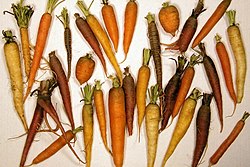
Carrots come in a wide variety of shapes and sizes.
Carrot cultivars can be grouped into two broad classes, eastern carrots and western carrots. More recently, a number of novelty cultivars have been bred for particular characteristics.
The world's largest carrot was grown in Palmer, Alaska by John Evans in 1998, weighing 8.6 kg (19 lb).[9]
The city of Holtville, California promotes itself as "Carrot Capital of the World", and holds an annual festival devoted entirely to the carrot.
Eastern carrots
Eastern carrots were domesticated in Central Asia, probably in modern-day Afghanistan in the 10th century, or possibly earlier. Specimens of the eastern carrot that survive to the present day are commonly purple or yellow, and often have branched roots. The purple colour common in these carrots comes from anthocyanin pigments.
Western carrots

Carrots with multiple taproots (forks) are not specific cultivars but are a byproduct of damage to earlier forks often associated with rocky soil.
The western carrot emerged in the Netherlands in the 15th or 16th century, its orange colour making it popular in those countries as an emblem of the House of Orange and the struggle for Dutch independence. The orange colour results from abundant carotenes in these cultivars. While orange carrots are the norm in the West, other colours do exist, including white, yellow, red, and purple. These other colours of carrot are raised primarily as novelty crops.
The Vegetable Improvement Center at Texas A&M University has developed a purple-skinned, orange-fleshed carrot, the BetaSweet (also known as the Maroon Carrot), with substances to prevent cancer, which has recently entered very limited commercial distribution, through J&D Produce of Edinburg TX. This variety of carrot is also known to be high in ß-carotene which is an essential nutrient. The high concentrations of this nutrient give the carrot its maroon shade.
Western carrot cultivars are commonly classified by their root shape:
- Chantenay carrots are shorter than other cultivars, but have greater girth, sometimes growing up to 8 centimetres (3 in) in diameter. They have broad shoulders and taper towards a blunt, rounded tip. They are most commonly diced for use in canned or prepared foods.
- Danvers carrots have a conical shape, having well-defined shoulders and tapering to a point at the tip. They are somewhat shorter than Imperator cultivars, but more tolerant of heavy soil. Danvers cultivars are often pureed as baby food.
- Imperator carrots are the carrots most commonly sold whole in U.S. supermarkets; their roots are longer than other cultivars of carrot, and taper to a point at the tip.
- Nantes carrots are nearly cylindrical in shape, and are blunt and rounded at both the top and tip. Nantes cultivars are often sweeter than other carrots.
While any carrot can be harvested before reaching its full size as a more tender "baby" carrot, some fast-maturing cultivars have been bred to produce smaller roots. The most extreme examples produce round roots about 2.5 centimetres (1 in) in diameter. These small cultivars are also more tolerant of heavy or stony soil than long-rooted cultivars such as 'Nantes' or 'Imperator'. The "baby carrots" sold ready-to-eat in supermarkets are, however, often not from a smaller cultivar of carrot, but are simply full-sized carrots that have been sliced and peeled to make carrot sticks of a uniform shape and size.
Carrot flowers are pollinated primarily by bees. Seed growers use honeybees or mason bees for their pollination needs.
Carrots are used as food plants by the larvae of some Lepidoptera species, including Common Swift, Garden Dart, Ghost Moth, Large Yellow Underwing and Setaceous Hebrew Character.
Novelty carrots
Food enthusiasts and researchers have developed other varieties of carrots through traditional breeding methods. Novelty carrots are also grown throughout Western Europe in flower pots and are noted for their distinctly minty flavour.[citation needed]
One particular variety lacks the usual orange pigment from carotenes, owing its white colour to a recessive gene for tocopherol (Vitamin E). Derived from Daucus carota L. and patented (US patent #6,437,222) at the University of Wisconsin-Madison, the variety is intended to supplement the dietary intake of Vitamin E.[10]
Production trends

Carrot and Turnip output in 2005. Green: largest producer (China). Yellow: other major producers. Red: minor producers
In 2005, China was the largest producer of carrots and turnips, according to the FAO. China accounted for at least one third of the global output, followed by Russia and the United States.
In 2005, a poll of 2,000 people revealed that the carrot was Britain's third favourite culinary vegetable.[11]
For the purposes of the European Union's "Council Directive 2001/113/EC of 20 December 2001 relating to fruit jams, jellies and marmalades and sweetened chestnut purée intended for human consumption" carrots can be defined as a fruit as well as a vegetable. This is because carrot jam is a Portuguese delicacy.
See also
Wikimedia Commons has media related to:
References
- , The Myths of Vegetarianism
- , Carrots at the Urban Legends Reference Pages
- , Kruszelnicki, K. S.. Carrots & Night Vision. Great Moments in Science. ABC.
- , Rose, F. (2006). The Wild Flower Key (O'Reilly, C., revised and expanded edition) London: Frederick Warne ISBN 0-7232-5175-4, p. 346
- , Mabey, R. (1997). Flora Britannica. London: Chatto and Windus ISBN 1-85619-377-2, p. 298
- , Dalby, A. (1996). Oxford Companion to Food Siren Feasts: A History of Food and Gastronomy in Greece. Routledge, ISBN 0-415-11620-1, p. 182
- , Dalby, A. (2003). Food in the Ancient World from A-Z. ISBN 0-415-23259-7, p. 75
- , Nowick, E. A. Daucus carota at Historical Common Names of Great Plains Plants
- , The World Record Carrot Grower
- , For an overview of the nutritional value of carrots of different colors, see Philipp Simon, Pigment Power in Carrot Color, College of Agricultural & Life Sciences, University of Wisconsin-Madison. Retrieved December 7, 2007.
- , Martin Wainwright. Onions come top for British palates. Guardian Unlimited. Guardian Newspapers Limited.
External links
(Source: Wikipedia) |
|