|
The northern river otter (Lontra canadensis) became one of the major animals hunted and trapped for fur in North America after European contact. River otters eat a variety of fish and shellfish, as well as small land mammals and birds. They grow to one metre (3 to 4 ft) in length and weigh from five to fifteen kilograms (10 to 30 lb).
In some areas this is a protected species, and some places have otter sanctuaries, which help ill and injured otters to recover.
[edit] Sea otter
-
Sea otters (Enhydra lutris) live along the Pacific coast of North America. Their historic range included shallow waters of the Bering Strait and Kamchatka, and as far south as Japan. Sea otters have some 200 thousand strands of hair per square centimetre of skin, a rich fur for which humans hunted them almost to extinction. By the time the 1911 Fur Seal Treaty gave them protection, so few sea otters remained that the fur trade had become unprofitable.
Sea otters eat shellfish and other invertebrates (especially clams, abalone, and sea urchins ), frequently using rocks as crude tools to smash open shells. They grow to 1.0 to 1.5 metres (2.5 to 5 ft) in length and weigh 30 kilograms (65 lb). Although once near extinction, they have begun to spread again, from remnant populations in California and Alaska.
Unlike most marine mammals (such as seals or whales), sea otters do not have a layer of insulating blubber. As with other species of otter, they rely on a layer of air trapped in their fur, which they keep topped up by blowing into the fur from their mouths. They spend most of their time in the water, whereas other otters spend much of their time on land.
[edit] Eurasian otter
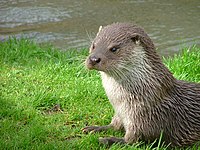
Eurasian otter, in England
-
Main article: Eurasian otter
This species (Lutra lutra) inhabits Europe, and its range also extends across most of Asia and parts of North Africa. In the British Isles they occurred commonly as recently as the 1950s, but became rare in many areas due to the use of chlorinated hydrocarbon pesticides and as a result of habitat-loss and water pollution (they remained relatively common in parts of Scotland and Ireland). Population levels attained a low point in the 1980s, but are now recovering strongly. The UK Biodiversity Action Plan envisages the re-establishment of otters by 2010 in all the UK rivers and coastal areas that they inhabited in 1960. Roadkill deaths have become one of the significant threats to the success of their re-establishment.
[edit] Giant otter
-
Main article: Giant otter
The giant otter (Pteronura brasiliensis) inhabits South America, especially the Amazon river basin, but is becoming increasingly rare due to poaching, habitat loss, and the use of mercury and other toxins in illegal alluvial gold mining. This gregarious animal grows to a length of up to 1.8 metres (6 ft), and is more aquatic than most other otters.
[edit] Cultural references
Norse mythology tells of the dwarf Ótr habitually taking the form of an otter. The myth of Otter's Ransom[4] is the starting point of the Volsunga saga.
In some Native American cultures, otters are considered totem animals.
The otter is held to be a clean animal belonging to Ahura Mazda in Zoroastrian belief, and taboo to kill.[5]
[edit] Gallery
Oriental small-clawed otter
|
Long-tailed otter in Tortuguero, Costa Rica
|
otters at the Perth Zoo, Western Australia
|
|
[edit] References and further reading
Wikimedia Commons has media related to:
- , "Birds of a feather..." (July/August 2004). Natural History 113 (6): 71. Retrieved on 2006-12-07.
- , Koepfli KP, Deere KA, Slater GJ, et al (2008). "Multigene phylogeny of the Mustelidae: resolving relationships, tempo and biogeographic history of a mammalian adaptive radiation". BMC Biol. 6 (1): 4–5. doi:10.1186/1741-7007-6-10. PMID 18275614.
- , Bininda-Emonds OR, Gittleman JL, Purvis A (1999). "Building large trees by combining phylogenetic information: a complete phylogeny of the extant Carnivora (Mammalia)". Biol Rev Camb Philos Soc 74 (2): 143-75. PMID 10396181.
- , The Otter's Ransom. Retrieved on 2007-07-05.
- , Cooper, JC (1992). Symbolic and Mythological Animals. London: Aquarian Press, p. 171-72. ISBN 1-85538-118-4.
- Gallant, D., L. Vasseur, & C.H. Bérubé (2007). Unveiling the limitations of scat surveys to monitor social species: a case study on river otters. Journal of Wildlife Management 71:258–265.
[edit] External links
(Source: Wikipedia) |