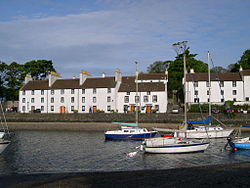
The village harbour at Cramond, with 18th century mill workers' housing in the background.
Cramond (Gaelic: Cathair Amain) is a village situated on the east side of the River Almond where it enters the Firth of Forth forming a natural harbour, now a suburb of Edinburgh, in Scotland. Excavations have revealed a Roman past and, as of 2004, the oldest human site in Scotland. It was the birthplace of the Scottish economist John Law.
[edit] Cramond today
The older houses along the wharf are typical of traditional south-east Scottish vernacular architecture, constructed in stone with harling white lime render finish, with facing stone window and door surrounds and crow-step gables, roofed with orangey-red clay pantiles imported from the Netherlands. A ruined water mill lies further up the Almond along a quiet walk past a yacht club and sailing boats moored in the river.To the east a sand beach and waterfront esplanade provides a popular walk to Silverknowes and Granton. On the other side of the Almond, (once accessible by a rowing-boat ferry) the Dalmeny Estate has a pleasant walk through Dalmeny Woods along the shore of the Firth of Forth. It belongs to the postal district EH4.
Offshore, Cramond Island has WW II fortifications and is linked to land by a causeway with a line of concrete pylons on one side, constructed as a submarine defence boom. At certain low tides sand extends to the island, tempting visitors to visit the island, though occasionally some are stranded by the incoming tide.
[edit] History

A map showing the parish of Cramond in 1794.
Cramond developed slowly over the centuries, with Cramond Kirk being founded in 1656. After a brief period spent as an industrial village in the late 18th and early 19th centuries, by the late 19th century it become a desirable suburb of Edinburgh, which it remains to this day.
[edit] Mesolithic period
Excavations of the Roman site uncovered finds including numerous burnt hazelnut shells which were radiocarbon dated to around 8500 BC, indicating a settlement significantly older than any previous human occupation finds in Scotland. Pits and postholes suggest a hunter-gatherer encampment, and microlith stone tools made at the site predate finds of similar style in England. Although no bones or shells had survived the acid soil, the carbonised hazelnut shells indicate cooking in a similar way to finds at later Mesolithic period sites including Britain's oldest house at Howick in Northumberland, dated to 7600 BC
[edit] Roman period

Site of the Roman Fort at Cramond.
Around 142, Roman forces arrived at Cramond by order of Emperor Antoninus Pius, who had given them the task of establishing a fort at the mouth of the River Almond. This fort would guard the eastern flank of the frontier that the Romans had established across Scotland. Nearly five hundred men worked on the site, building a fort that covered nearly six acres and a harbour for communication. However, the fort was only inhabited for a short time, perhaps fifteen years, before it was abandoned by the troops who were ordered to retreat south to Hadrian's Wall. Pottery and coins of later date indicate that the fort and harbour were reinhabited and used as a base for the army and navy of the Emperor Septimus Severus, sometime between 208 and 211.
The medieval parish church of Cramond parish (which retains its late medieval western tower in altered form), was built within the Roman fort, which also gave its name to the village (Brythonic Caer Amon, 'fort on the Almond').
Though knowledge of the Roman presence at Cramond was recorded afterwards, the remains of the fort itself were only rediscovered in 1954. Substantial archaeological research was carried out upon its discovery to build up a reasonably accurate picture of the site in Roman times. The fort was rectangular in shape, with walls fifteen feet high on all sides. A gatehouse was set in every wall, allowing access in all four directions. Inside, there were barracks, workshops, granaries, headquarters and the commander's house. Later excavations revealed other constructions outside the boundary of the fort, including a bath-house, further industrial workshops and a native settlement.
In 1997 the Cramond Lioness was uncovered in the harbour mud by a local boatman (who received a substantial monetary reward for finding this major antiquity), and was identified as a sandstone statue of a lioness devouring a hapless male figure, probably one of a pair at the tomb of a military commander. After conservation, the statue was displayed in the Museum of Scotland in Edinburgh. It is one of the most ambitious pieces of Roman sculpture to have survived in Scotland.
[edit] Medieval period
A tower-house, probably built in the early 15th century, and part of a now-demolished larger establishment, was once a manor house of the Bishops of Dunkeld, of whose diocese Cramond was a part. It was made structurally sound and converted to a private dwelling in the 1980s.
[edit] References
[edit] External links
Coordinates: 55°58'N, 3°18'W
(Source: Wikipedia) |