| |
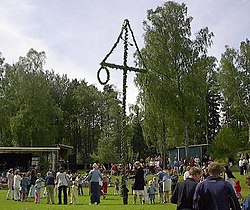
Dancing around the maypole, in Åmmeberg, Sweden
The maypole is a tall wooden pole (traditionally of maple (Acer), hawthorn or birch), sometimes erected with several long coloured ribbons suspended from the top, festooned with flowers, draped in greenery and strapped with large circular wreaths, depending on local and regional variances. What is often thought of as the "traditional" English/British maypole (a somewhat shorter, plainer version of the Scandinavian pole with ribbons tied at the top and hanging to the ground) is a relatively recent development of the tradition and is probably derived from the picturesque, Italianate dances performed in mid-19th century theatricals. It is usually this shorter, plainer maypole that people (usually school children) perform dances around, weaving the ribbons in and out to create striking patterns.
With roots in Germanic paganism, the maypole traditionally appears in most Germanic countries, Germanic country-bordering and countries invaded by Germanic tribes after the fall of the Roman Empire (like Spain, France and Italy), but most popularly in Germany, Sweden, Austria, the United Kingdom, the Czech Republic, Hungary, Slovakia, Slovenia, and Finland in modern times for Spring, May Day, Beltane and Midsummer festivities and rites.
[edit] Regional traditions
-
In Greece people do the maypole dance. Maypole is referred as Mayoksylo ( ?a???????)and it also has a phallic symbolism. Mayoksylo is the trunk of a young cypress tree, decorated with yellow daisies and fruits. People traditionally gather wild flowers and make a wreath with them.
In Corfu island they have to steal the flowers from gardens to make the wreath. They hang this wreath on the front door and they burn it in the bonfires of summer solstice, the day of St John the Baptist's birthday also known as midsummer (June 24).
In the south, especially in the island of Krete they avoid marriages, as May is considered to be the month of the dead and the marriage would be an unlucky one.
In Sweden it is usually called a midsommarstång, as it appears at the Midsummer celebrations, but it is also called majstång.
Sometimes a crown of flowers is placed on top of the maypole, supported by the ribbons, so that it gradually descends the pole as the ribbons are woven together, finally falling to the ground.

A maypole at the Viktualienmarkt in Munich, Germany
Today maypole dances are often done without dividing the participants by gender, simply having them in pairs facing one another so half go one way and half go the other.
In Sweden similar traditions were once observed but today the pole is the centre of traditional ring dances, the songs being more or less the same as during the dances around the Christmas tree. Arrangements are usually made by local traditional groups. Swedish speaking parts of Finland often celebrate Midsummer with a midsommarstång as well. And people also did maypole dancing with ribbons tied to a pole and then when it was finished it looked very impressive.

Villagers & Morris-men dancing beside the Maypole on Ickwell Green, Bedfordshire; Dawn on 1st May 2005.
In the 16th century maypoles were communal symbols, being erected as group activities by a parish (or by several parishes in concert if they did not have the means to do so individually). They were often the focus of rivalries between villages, who would steal one anothers' poles. (In Hertfordshire in 1602 and in Warwickshire in 1639 such thefts led to violence.) Owners of woods and forests (such as the Earl of Huntingdon in 1603 who was furious to discover that his estates had been the source of the maypoles used in Leicester) were also the victims of theft, as it was often the case that they were not consulted about the use of their timber.[1]
Hostility towards maypoles, emanating from evangelical Protestants, grew, first manifesting itself significantly during the Reformation of Edward VI, when a preacher denounced the Cornhill maypole as an idol, causing it to be taken out of storage, sawn up, and burned. Under Mary and Elizabeth I this opposition to traditional festivities lacked government support, with Elizabeth recorded as being fond of them, but Protestant pressure to remove maypoles, as a symbol of the mixed-gender dancing, drunkenness, and general merry-making on Sundays that they opposed (see Sabbatarianism), grew nonetheless. Between 1570 and 1630, maypoles were banned from Banbury, Bristol, Canterbury, Coventry, Doncaster, Leicester, Lincoln, and Shrewsbury; and there is no historical evidence for their use inside the city limits of London. Of the four Berkshire villages whose accounts still exist, three sold their maypoles between 1588 and 1610. However, the trend was not uniformly towards the banning of maypoles. There are many records of their continued use in the 1630s, and Charles I and James I explicitly allowed maypole dancing on Sundays.[1]
That royal support contributed to the outlawry of maypole displays and dancing during the English Interregnum, by the Long Parliament's ordinance of 1644, describing maypoles as "a Heathenish vanity, generally abused to superstition and wickedness"[1]. The only recorded breach of the Long Parliament's prohibition was in 1655 in Henley-in-Arden, where local officials stopped the erection of maypoles for traditional games. Scholars suspect, but have no way to prove, that the lack of such records indicates official connivance in flouting of the prohibition. However, they are certain that the prohibition turned maypole dancing into a symbol of resistance to the Long Parliament and to the republic that followed it.[1]
When the Restoration occurred in 1660, common people in London, in particular, put up maypoles "at every crossway," according to Aubrey. The largest was in the Strand, near the current St Mary-le-Strand church. The maypole there was the tallest by far, and it stood until being blown over by a high wind in 1672, when it was moved to Wansted in Essex and served as a mount for a telescope.[2][1]
In the countryside, may dances and maypoles appeared sporadically even during the Interregnum, but the practice was revived substantially and joyously after the Restoration. By the 19th century, the maypole had been subsumed into the symbology of "Merry England." The addition of intertwining ribbons seems to have been influenced by a combination of 19th century theatrical fashion and visionary individuals such as John Ruskin in the 19th century. Pairs of boys and girls (or men and women) stand alternately around the base of the pole, each holding the end of a ribbon. They weave in and around each other, boys going one way and girls going the other and the ribbons are woven together around the pole until the merry-makers meet at the base.
There are also more complex dances for set numbers of (practised) dancers, (the May Queen dancing troups), involving complicated weaves and un-weaves, but they're not well known today. However, such dances are performed every Mayday around the permanent Maypole at Offenham, in Worcestershire. Temporary Maypoles are usually erected on village greens and events are often supervised by local Morris dancing groups.
A somewhat different Mayday Maypole tradition existed in some regions, which was the carrying of smaller, highly decorated sticks, with hoops or cross-sticks or swags attached, covered with flowers, greenery or artificial materials such as crepe paper. Children would take these hand-held poles to school on May Day morning and prizes may be awarded for the most impressive. This tradition is known as garlanding and was a central feature of Mayday celebrations in central and southern England until the mid-19th century when it began to be replaced by formally organised school-centred celebrations. It still occurs from place to place but is invariably a reinstatement of a local custom that had lapsed decades earlier.
In 1780 Kilmarnock Council, now in East Ayrshire, paid Robert Fraser 2s. 6d. for dressing a Maypole, one of the last recorded examples of the rural festival of the first of May in Scotland, having been put down by Act of Parliament immediately after the Reformation in 1560.[3]
The tallest maypole in Britain can be found in the village of Welford-on-Avon in Warwickshire.
The maypole (májka or máj) is also still popular in the Czech Republic, in country villages. Villages compete to get taller maypoles than their neighbors, and during the night the youths of a village guard the maypole to keep ruffians from neighboring villages from knocking it over (while at the same time attempting forays into neighboring villages to knock over the maypoles of others).

Children rehearsing around the Maypole, in Alabama, in 1910.
While not celebrated amongst the general public in the United States today, a Maypole Dance nearly identical to that celebrated in the United Kingdom is an important part of many Secondary or High School dances as part of a May Day celebration. Often the Maypole dance will be accompanied by other dances as part of a presentation to the public.
The early colony of Merrymount, founded by Thomas Morton, outraged its Puritan neighbours by setting up a maypole.
[edit] Early American Colonies
The earliest use of the Maypole in America occurred in 1628, where William Bradford, governor of New Plymouth, wrote of an incidence where a number of servants, together with the aid of an agent, broke free from their indentured service to create their own colony, setting up a maypole in the center of the settlement, and behaving in such a manner as to receive the scorn and disapproval of the nearby colonies, as well as an official officer of the king, bearing patent for the state of Massachusetts:
“Some three or four years before this there came over one, Captain Wollaston a man of fine qualities, with three or four others of some distinction, who brought with them a great many servants, with provisions and other necessaries to found a settlement. They pitched up n a place within Massachusetts, which they called after their Captain, Mount Wollaston. Among them was one, Mr. Morton, who, it seems, had some small share with them in the enterprise, either on his own account or as an agent; but he was little respected amongst them and even alighted by the servants. Having remained there some time, and not finding things answer their expectations, Captain Wollaston took the majority of the servants to Virginia, where he hired out their services, profitably to the employers. So wrote up Mr. Rasdell, one of the chief partners who was acting as their merchant, to bring another party of them to Virginia for the same purpose. With the consent of Rasdell he appointed one, Fitcher, as his deputy, to govern the remnant of the colony till one of them should return. But Morton, in the other’s absence, having more craft than honesty—he had been a kind of pettifogger of Furnival’s Inn—watched his opportunity when rations were scarce with them, got some drink and other junkets, and made them a feast, and after they were merry began to tell them he would give them good counsel. ‘You see,’ says he, ‘that many of your comrades have teen taken to Virginia; and if you stay till this Rasdell returns you too will carried off and sold as slaves with the rest. So, I would advise you to oust this Lieutenant Fitcher; and I, having a share in his settlement, will take you as partners, and you will be free form service, and we will trade, plant, and live together as equals, and support and protect one another’—and so on. This advice was easily received; so they drove out Lieutenant Fitcher and would not allow him to come amongst them, forcing him to get food and other relief from his neighbours, till he could get passage to England. They then fell into utter licentiousness, and led a dissolute and profane life. Morton became lord of misrule, and maintained, as it were, a school of Atheism. As soon as they acquired some means by trading with the Indians, they spent it in drinking wine and strong drinks to great excess,--as some reported, £10 worth in a morning. They set up a Maypole, drinking and dancing about it for several days at a time, inviting the Indian women for their consorts, dancing and frisking together like so many fairies, --or furies rather,-- to say nothing of worse practices. It was as if they had revived the celebrated feasts of the Roman goddess Flora, or the beastly practices of the mad Bacchanalians. Morton, to show his poetry, composed sundry verses and rhymes, some tending to lasciviousness and others to the detraction and scandal of some persons, affixing them to his idle, or idol, Maypole. They changed the name of the place, and instead of calling it Mount Wollaston, they called it Merry Mount, as if the jollity would last forever. But it did not continue long, for, shortly after, Morton was sent back to England, as will appear. In the meantime that worthy gentleman, Mr. John Endicott, arrived from England, bringing over a patent under the broad seal, for the government of Massachusetts. Visiting their neighborhood, he had the Maypole cut down, and reprimanded them for their profaneness, admonishing them to improve their way of living. In consequence, others changed the name of the place again, and called it Mount Dagon!”
[edit] Symbolism
The Maypole is often considered a phallic symbol, coinciding with the worship of Germanic phallic figures such as that of Freyr. One clear sexual reference is in John Cleland's controversial novel Fanny Hill:
- ...and now, disengag’d from the shirt, I saw, with wonder and surprise, what? not the play-thing of a boy, not the weapon of a man, but a maypole of so enormous a standard, that had proportions been observ’d, it must have belong’d to a young giant.
Potential other meanings include symbolism relating to the Yggdrasil, a symbolic axis linking the underworld, the world of the living, the heavens and numerous other realms. Also likely related, reverence for sacred trees can be found in surviving accounts of Germanic tribes, for example, Thor's Oak, Adam of Bremen's account of Sacred groves and the Irminsul.[citation needed]
The present day tradition of maypoles coincides geographically with the area of influence of the Germanic mythos.
The assertion of phallic symbolism in relation to Maypoles reflects its current semiotic values: celebration, community, youthfulness and the arrival of summer.
[edit] Modern popular culture
- A maypole was featured in Men Without Hats' music video for the song "The Safety Dance".
- The 1973 British film The Wicker Man features a musical scene with boys dancing around a maypole while singing a pagan song. The scene is continued in a classroom where an all girl class is taught the phallic symbolism of the maypole.
[edit] References
- , a b c d Ronald Hutton (2001). The Stations of the Sun.: A History of the Ritual Year in Britain. Oxford University Press, 235–236. ISBN 0192854488.
- , (1967) "Maypole in the Strand", in Harvey, Paul and Dorothy Eagle: The Oxford Companion to English Literature. Oxford: Oxford University Press, 528–529.
- , Paterson, James (1863–1866). History of the Counties of Ayr and Wigton. Edinburgh: J. Stillie, 394–395.
[edit] See also
[edit] External links
Wikimedia Commons has media related to:
(Source: Wikipedia) |
|